Contractor comebacks cost R3,550 each on average — insurance admin, contractor admin, direct costs and opportunity cost combined. The top five causes are rushed work under SLA pressure (35%), wrong diagnosis (25%), cheap materials (20%), incomplete work (15%), and no testing before leaving (5%). Mandatory diagnostic checklists and quality materials are the highest-impact fixes.
Every comeback costs more than the direct job cost. There’s the direct cost (labour and materials again), the admin cost (paperwork, insurer communication, scheduling), the opportunity cost (that technician could have been on a paying job), and the panel score impact (above 8% comeback rate triggers insurer concern). Here’s how to reduce your comeback rate to below 5% and save R298,000/year.
- Comeback cost: R3,550 each on average
- Target rate: Below 5% excellent, 5–8% acceptable, above 8% = insurer concern
- Prevention ROI: Reducing from 10% to 3% saves R298K/year (100 jobs/month)
- Top causes: Rushed work 35%, wrong diagnosis 25%, cheap materials 20%
The True Cost of a Comeback
Most contractors underestimate comeback costs because they only count the direct labour and materials. The full picture:
- Insurance admin cost: R750 — insurer administration, re-inspection paperwork, DAS reassignment
- Contractor admin cost: R400 — scheduling the return, customer communication, updated documentation
- Direct cost: R400 — travel (second trip), any additional materials
- Opportunity cost: R2,000–2,500 — that technician’s time, which could have been a paying job
- Total per comeback: R3,550–4,050
The panel risk: Insurers track comeback rates. Above 8% triggers informal concern. Above 12% triggers formal warning. Above 15% can result in panel suspension — losing 60–70% of your revenue. Comebacks don't just cost money directly; they threaten your entire panel income.
The 5 Main Causes of Comebacks
Cause 1: Rushed Work Under SLA Pressure (35% of comebacks)
The most common cause. Team is 47 minutes into a 60-minute emergency SLA, they’re rushing to get the clock stopped. They solve the presenting problem but miss the underlying cause. The geyser element is replaced, but the thermostat that caused the element to burn out isn’t checked. Two weeks later, the new element fails too. Comeback.
The fix: Separate the SLA completion from the quality of work. Arriving on time (GPS check-in stops the clock) buys you the time to do the work properly. Once you’ve checked in, the SLA pressure is off — use the time you’ve bought to do a complete job.
Cause 2: Wrong Diagnosis (25% of comebacks)
Replace the element when the thermostat is the problem. Fix the visible leak without tracing it to the source. The comeback here isn’t about quality of execution — it’s about incomplete diagnosis. The technician fixed what they saw, not what was actually wrong.
The fix: Diagnostic checklists per job type. A geyser job checklist includes: element (test), thermostat (test), pressure control valve (inspect), all connections (check for weeping), drip tray (check for rust/evidence of previous leaks). Sign off every item. Don’t leave until the checklist is complete.
Cause 3: Cheap Materials (20% of comebacks)
A budget geyser element that costs R180 instead of R350 saves R170 on the job. But the budget element has a 40% chance of failing within 12 months vs 8% for the quality element. On 100 geyser jobs per month, that’s 32 extra comebacks per year from elements alone. At R3,550 per comeback: R113,600/year in comeback costs from saving R17,000 on elements.
The fix: Calculate total cost of ownership including comeback probability. Create approved materials lists per job type. Train technicians on the maths: cheaper materials cost more in comebacks than they save in purchase price. Almost always.
Cause 4: Incomplete Work (15% of comebacks)
Fixed the burst pipe but didn’t check the pressure valve that caused the burst. Replaced the DB breaker but didn’t test the circuit. Cleared the blocked drain but didn’t check why it blocked (tree roots, scale buildup).
The fix: Every job type needs a completion checklist that requires sign-off on related components before the job can be marked complete in the app. The technician cannot submit the job without confirming they’ve checked everything on the list.
Cause 5: No Testing Before Leaving (5% of comebacks)
The most preventable category. Geyser installed correctly, but the technician leaves before testing because it takes 45 minutes for the element to heat and they have another job. Customer calls 2 hours later: still cold water. Element wired to neutral instead of live. 45-minute wait that wasn’t done costs a 2-hour return visit.
The fix: Make testing mandatory. Even partial testing (electrical continuity check, pressure test, initial flow test) catches the vast majority of failures before the technician leaves. Build the test time into job scheduling.
Prevention Strategies That Actually Work
Strategy 1: Diagnostic Checklists in the Job Card App
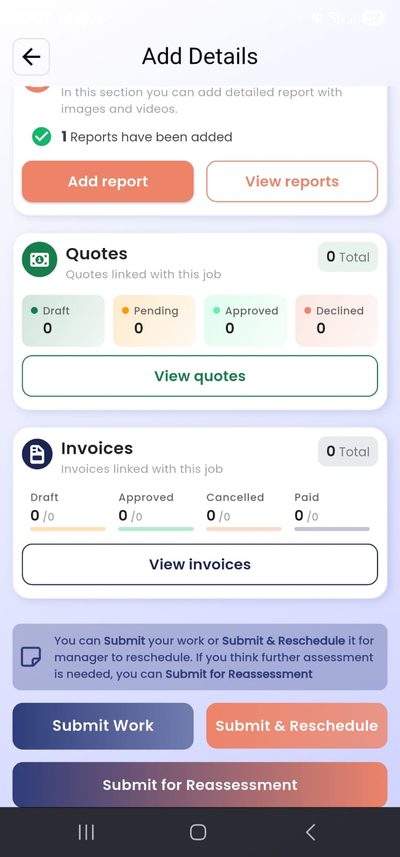
Create a checklist per job type that the technician must complete before the job can be marked done in the mobile app. The system enforces completion — they can’t submit without ticking every item.
Example geyser checklist:
- Element tested (resistance reading recorded)
- Thermostat tested (temperature setting confirmed)
- Pressure control valve inspected and tested
- All pipe connections checked (no weeping)
- Drip tray inspected (no evidence of previous or current leaks)
- Cold water inlet valve operational
- Initial heat-up test started (temperature rising confirmed)
- Customer informed of expected heat-up time
Strategy 2: Mandatory Photos — Before and After
Requiring minimum 5 photos per job does two things simultaneously: it creates an evidence record, and it forces the technician to slow down and document the job properly. The act of taking a “before” photo almost always reveals additional issues that rushing would miss. The “after” photo forces a final visual check of the work.
Strategy 3: Approved Materials Lists
Create an approved materials list per job category. Use quality brands (guaranteed 5 years, not budget 12-month warranties) for high-failure components: elements, thermostats, pressure valves, flexible hoses. The savings in comeback prevention outweigh the purchase price difference by 3–5x.
Track your comeback rate by material used. You will quickly identify which budget materials are generating repeat visits.
Strategy 4: Customer Education Before You Leave
Up to 20% of “comebacks” are actually normal post-repair behaviour that the customer interprets as a failure. New geysers take 45–60 minutes to heat. A repaired pressure valve drips for 24 hours while normalising. Earth leakage breakers trip when old appliances are plugged in.
If you educate the customer about what to expect before you leave, these callbacks don’t happen. If they call, the education helps them understand what they’re seeing is normal and avoids a “comeback” being logged against your record.
The Comeback Rate as a Business Health Metric
Most contractors track their comeback rate reactively — they notice when a customer calls back or when the panel coordinator mentions it. The contractors who get below 3% track it proactively, weekly, as a core business metric.
Here is what a weekly comeback tracking process looks like in practice:
- Every Monday morning: pull list of jobs completed 15–30 days ago
- Cross-reference against new job assignments for the same customer and address
- Any match = potential comeback. Review the original job record, photos, and technician notes
- Classify each comeback: materials failure, diagnosis error, rushed work, incomplete work, customer education failure
- Update the technician and materials tracking
This process takes 20 minutes in PMC where the data is already organised. Without tracking software, it takes 2+ hours of manual cross-referencing and is usually done monthly (too late to catch patterns) or not at all.
Industry-Specific Prevention Strategies
For Plumbing Contractors: The Geyser Comeback Problem
Geyser-related comebacks are the single highest-volume comeback category for plumbing contractors on insurance panels. The most common geyser comebacks and their specific prevention:
- Element failure within 90 days: Almost always a materials quality issue. Use quality copper elements with manufacturer warranty. Budget elements have 40% failure rate within 12 months. Quality elements: 8% failure rate over 5 years. The R170 saving on the element costs R3,550 in the comeback.
- Thermostat not reset after element replacement: Prevention: checklist item “thermostat reset to 55°C and tested” required before job completion.
- Pressure control valve not replaced (when needed): Prevention: inspection of PCV required on every geyser job, replacement decision documented.
- Pipe connection weeping after repair: Prevention: all connections pressure-tested before leaving.
For Electrical Contractors: The DB Board Comeback Problem
- Wrong breaker rating: Prevention: original circuit design check before replacement, not just like-for-like swap.
- Earth leakage tripping after earth leakage replacement: Often means the fault that caused the original trip is still present. Prevention: full circuit test after installation before marking complete.
- Multiple breaker trips after DB work: Often indicates a neutral issue that was disturbed during the work. Prevention: neutral connections checked and torqued after any DB work.
- COC issued for incomplete work: Issuing a COC for work that wasn’t fully completed is both a comeback risk and a compliance risk. Prevention: mandatory walk-through of entire scope before COC sign-off.
Technician Training for Comeback Prevention
Technical skill is only part of comeback prevention. The rest is process discipline — doing the checklist steps even when the job looks simple, taking the photos even when it’s a quick job, testing even when you’re confident the installation is correct.
This is where training focus often falls short. Most contractors train on technical skills (how to install a geyser, how to wire a DB board) but not on process discipline (how to use the checklist, why photos matter, how to do a proper pressure test).
The Process Training Approach
For new technicians (first 3 months):
- Shadow a senior technician for the first 2 weeks — observe checklist use, not just technical work
- First solo jobs audited: branch manager reviews photos and job record within 24 hours
- Weekly debrief: any comebacks from the week reviewed together, root cause discussed, learning documented
For experienced technicians:
- Monthly comeback rate published per technician (not shamed, data-shared)
- Quarterly best-practice session: team shares what’s working, cases from recent comebacks reviewed collectively
- Incentive structure: technicians with zero comebacks in a quarter receive recognition or bonus
The Customer Experience and Comebacks
Some “comebacks” are not technical failures. They are customer service failures that get reported as technical issues.
Scenario: a geyser is installed correctly and is working perfectly. The customer calls back because the water isn’t as hot as before. The new thermostat is set to 55°C (the SA standard, higher is a scalding risk). The customer’s previous geyser, after 15 years of calcification, was running at 70°C. The new one feels “colder”. Technically: no fault. Outcome without education: comeback call, technician dispatched, time wasted, comeback recorded against your rate.
Customer education scripts for the most common misconceptions:
- New geyser heat: “Your new geyser is set to 55°C which is the SA safety standard. It will feel slightly different to your old geyser if it was running hotter. This is normal and correct.”
- Pressure valve dripping: “The pressure relief valve may drip slightly for 24–48 hours while it adjusts to the new system. This is normal. If it’s still dripping after 48 hours, call us.”
- Earth leakage and old appliances: “The new earth leakage is working correctly. If an appliance trips it, that means the appliance has an earth fault. This is the earth leakage protecting you, not a fault in our installation.”
Financial Incentives for Zero-Comeback Performance
Beyond the cost-saving motivation, consider building comeback prevention into your performance incentive structure:
- Individual comeback rate bonus: Each technician with zero comebacks in a month receives a R500 bonus. Cost if entire 10-team operation hits zero comebacks: R5,000/month. Annual cost: R60,000. Comeback saving at 3% vs 10% rate on 100 jobs/month: R248,500/year. ROI: 4x+.
- Team comeback rate bonus: When the entire operation achieves <3% for a quarter, everyone receives a day off or equivalent benefit. Creates team accountability, not just individual accountability.
- Negative consequences: Technicians with comeback rates above 10% for 3 consecutive months are placed on a performance improvement plan. Comebacks that are clearly caused by deliberate shortcuts (not genuine errors) are addressed as disciplinary matters.
Comeback Prevention vs SLA Compliance: Managing Both Simultaneously
The biggest tension in insurance panel work is that SLA compliance and comeback prevention pull in opposite directions. SLA compliance creates time pressure (arrive fast), comeback prevention requires thoroughness (take time to do it right).
The resolution is structural, not attitudinal:
- Arrival stops the SLA clock. The 60-minute SLA is met the moment you GPS check-in within 40 metres of the address. What happens after that is not on the SLA timer. You have as much time as the job requires once you’re on site.
- Zone coverage removes the time pressure. When your team is pre-positioned within 25 minutes of any job in their zone, there is no SLA pressure-induced rushing. They arrive with time to spare and can be thorough.
- Checklists are faster than fixing comebacks. A 5-minute checklist on site costs far less time than a 2-hour return visit, customer apology, revised documentation, and the mental overhead of dealing with a complaint.
The contractors who achieve both 98%+ SLA compliance and <3% comeback rates simultaneously have structured their operations so that speed and thoroughness are not in conflict. The structure is the solution, not harder work. Read the SLA compliance guide for the structural approach →
Tracking Your Comeback Rate
Comeback rate = (return visits for same issue within 30 days) ÷ (total jobs completed) × 100.
Track this monthly. Break down by:
- Technician: which team members have consistently higher comeback rates? Training need identified.
- Job type: which job categories generate most comebacks? Checklist improvements needed.
- Materials: which component failures are recurring? Materials list update needed.
- Cause: was it diagnosis, materials, rushing, or no testing? The fix is different for each.
PlanMyCrew tracks all job completions and return visits automatically, making this analysis straightforward. Without tracking software, this analysis requires manual records that most contractors don’t maintain consistently.
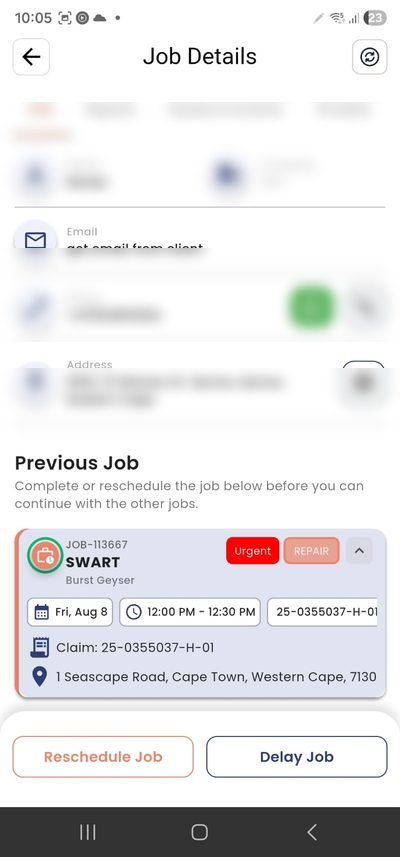
Enforce Quality Standards on Every Job
PlanMyCrew enforces photo requirements and diagnostic checklists before jobs can be marked complete. Prevent comebacks before they happen. 30-day free trial.