SA contractors lose an average of R1,200/month (R14,400/year) to fuel fraud through office-origin lies, scenic route inflation and personal errands on company fuel. The only way to eliminate it completely is 40-metre GPS attendance enforcement — which blocks clock-in unless the technician is physically on site. PlanMyCrew is the only SA software with this feature.
Contractor fuel fraud is one of those problems nobody talks about openly but almost every SA contractor managing multiple teams has experienced. I lost R14,400 in one year before I built a system to stop it completely. Here’s exactly what was happening, how I discovered it, and how to eliminate it entirely.
- Typical fraud: R1,000–1,300/month per 10-team operation (10% of fuel budget)
- Three main schemes: Office origin lies (R87/trip), scenic route inflation (R57/trip), personal errands (R40/day)
- Solution: 40-metre GPS attendance lock — clock-in blocked unless physically on site
- Annual saving: R14,400/year average
- Only software with 40m enforcement: PlanMyCrew
The Three Most Common Fuel Fraud Schemes
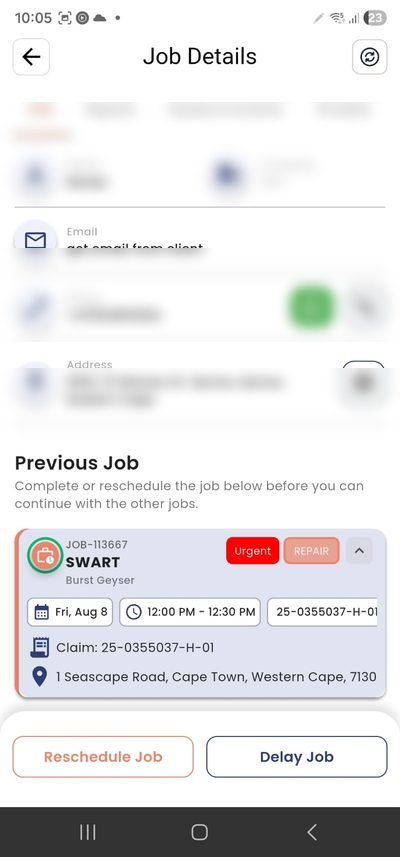
Scheme 1: The Office Origin Lie (R87.50 per trip)
The most common and most expensive scheme. The contractor claims they drove from the office (50km from the job site) when they actually started from home (15km from the site). The difference: 35km of fraudulent mileage claimed at R2.50/km.
R87.50 per trip. For a technician doing this on every job, 3 jobs per day, 5 days per week: R5,775/month from one person. Across a 10-team operation where even 20% of your team does this on a portion of jobs, the numbers accumulate fast.
Why it’s hard to catch without enforcement: The technician DID go to the job. The claim is for mileage, not for a job they didn’t attend. Without GPS tracking that records their actual route from actual starting point, you have no way to dispute it.
Scheme 2: Scenic Route Inflation (R57.50 per trip)
Claiming a 65km route when the actual route was 42km. The technician travels from Point A to Point B, but takes a longer route and claims the longer mileage. The extra 23km at R2.50/km = R57.50 per trip.
This is harder to catch than the origin lie because both the claimed route and the actual route end at the same destination. Basic GPS tracking that only shows the final location can’t catch this. You need route tracking from start to finish, which most field service GPS systems don’t provide.
Scheme 3: Personal Errands on Company Fuel (R40/day)
Gym before the first job. School pick-up between jobs. Shopping on the way back to the depot. All on company fuel. This isn’t a one-off — it’s a daily habit for some technicians who view company fuel as a personal perk.
At R40/day per technician, that’s R800/month per person. For a 10-team operation where 2–3 people do this regularly, you’re looking at R2,000–2,400/month in personal use costs before any legitimate jobs have been driven.
How I Discovered the Fraud in My Business
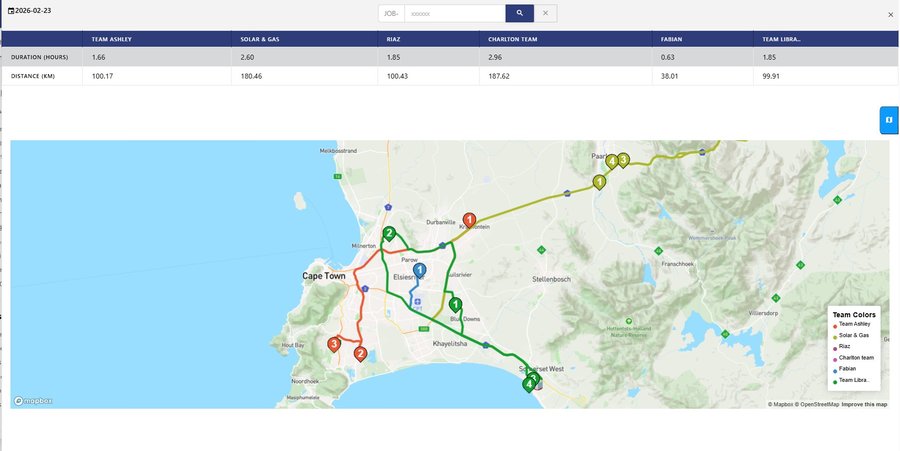
I didn’t discover it by catching someone red-handed. I discovered it by accident. When I implemented basic GPS tracking (before the enforcement feature), my fuel costs dropped by R1,200 the first month — without changing routes, without changing team size, without any other operational change.
The fraud stopped simply because people knew they were being tracked. But that only lasted 6 weeks. Once they realised the GPS was tracking location only (not route or start point), the costs crept back up. The tracking was visible but not enforced.
The real elimination came when I built and implemented the 40-metre clock-in lock. From Month 2 after enforcement, the saving was consistent and permanent. The behaviour didn’t reduce — it stopped. Because it couldn’t happen anymore, not because people chose to stop.
Why Basic GPS Tracking Isn’t Enough
This is where most field service software fails. They offer GPS tracking and present it as a fraud prevention tool. It’s not. There’s a fundamental difference between tracking and enforcement:
- Tracking tells you where they went after the fact — useful for disputes, useless for prevention
- Enforcement makes the fraud physically impossible before it happens
| Software | GPS Feature | Prevents clock-in fraud? |
|---|---|---|
| ServCraft | GPS visibility + timestamps | ✕ Trust-based only |
| Tradify | Basic GPS tracking | ✕ No enforcement |
| Eworks | Location tracking | ✕ Tracking only |
| PlanMyCrew | 40m geofenced enforcement | ✓ Clock-in blocked if not on site |
How the 40-Metre GPS Lock Works
When a technician taps “Clock In” on the PlanMyCrew mobile app, the system checks their GPS coordinates against the job site address in real time. The comparison is instant:
- Within 40 metres of the job address: clock-in approved, timestamped with exact coordinates
- More than 40 metres from the job address: clock-in button disabled, manager alert sent, technician shown their distance from site
There is no override. There is no “I’m just running late” button. The technician must be physically on site. Period.
Why 40 Metres Is the Right Distance
- GPS accuracy on modern smartphones: typically ±10–20 metres
- Large residential properties: house to front gate can be 25–30 metres
- Apartment buildings: parking to unit entrance can be 30–40 metres
- Too tight (10m): legitimate check-ins fail on large properties
- Too loose (100m): technician can clock in from the house next door
- 40m = the sweet spot that works for 99%+ of SA properties
The Insurance Panel Bonus: Attendance Proof
Beyond fraud prevention, the 40-metre GPS lock solves a second critical problem: insurance panel attendance verification.
SA insurance panels require GPS proof of attendance. When a customer disputes that your contractor arrived (“they say they were there, but I was home and no one came”), you need verifiable evidence. When your panel coordinator audits SLA compliance, they need timestamped, location-verified arrival records.
The 40m GPS lock produces exactly this automatically — a timestamped, location-verified record accurate to within 40 metres of the job address, stored permanently in the job record. No manual record-keeping. No possibility of dispute. Read more about SA insurance panel requirements →
Real ROI Calculation
For a 10-team operation (conservative estimates):
- Average fraudulent fuel per team per day: R40–60 (mixed schemes)
- Conservative monthly estimate across 10 teams: R1,200/month
- Annual saving with 40m enforcement: R14,400/year
PlanMyCrew Field Pro at R350/user/month for 10 users = ~R3,500/month = R42,000/year.
The fuel fraud saving alone covers 34% of the annual software cost. But the fuel fraud is just one item — add SLA compliance maintenance (preventing suspension that would cost 60–70% of revenue), admin time saving (45 minutes down to 8 minutes per day), invoice accuracy, and the ROI calculation becomes overwhelming.
What Happens When You Implement GPS Enforcement
Based on my own experience and feedback from other PMC users:
- Day 1–7: Team asks questions. “What happens if GPS is inaccurate?” “What if I’m at a multi-unit building?” Answer every question directly — the system is fair and the 40m buffer handles real-world GPS limitations.
- Week 2–4: Some team members try workarounds. Moving their phone closer to the address. Waiting outside the gate. The system is robust enough to handle this — 40 metres means on the property, not in the street.
- Month 2+: Behaviour normalises. Teams who were honest feel vindicated — the playing field is now level. Teams who were committing fraud simply stop. Fuel costs drop to legitimate levels and stay there permanently.
- Unexpected benefit: Dispute resolution becomes instant. Customer says “contractor never arrived” — you pull up the GPS record: check-in 38 metres from address, 10:14 AM. Dispute closed.
Practical tip: When you implement GPS enforcement, communicate it to the team proactively. Don't present it as a surprise or a punishment. Present it as: (1) protection for honest team members, (2) proof for dispute resolution, (3) required for insurance panel documentation. Most honest team members will welcome it.
The Psychology of Fuel Fraud: Why It Happens and Why It Persists
Most technicians who commit fuel fraud don’t think of themselves as stealing. They think of it as informal compensation for what they perceive as underpayment or overlooked contributions. It’s rationalised as “I used my own tools last month” or “they never reimburse me when I use my personal vehicle.”
This matters because enforcement alone stops the behaviour but doesn’t always address the underlying perception. When you implement GPS enforcement, accompany it with a direct team conversation: “We’re implementing this because we need accurate records for insurance claims and SLA compliance proof. It also protects you when a customer disputes attendance. This is not about trust — it is about documentation.”
Honest team members will immediately understand and support this. Technicians who have been committing fraud will know what it actually means, but the professional framing gives everyone a reason to accept the change without feeling individually accused.
GPS Evidence in Insurance Disputes
Beyond fraud prevention, the 40m GPS clock-in serves a critical second function: resolving insurance claim disputes.
The scenario happens regularly: a customer tells the insurer that the contractor never arrived, or arrived 30 minutes after the SLA deadline. Without GPS evidence, it’s your word against theirs. Insurance panels typically side with the customer in contested cases, marking an SLA breach and sometimes requiring a costly revisit at your expense.
With 40m GPS evidence: you pull up the job record instantly. GPS check-in timestamp: 10:47am. Coordinates: verified within 38 metres of 14 Protea Street, Bellville. SLA deadline: 11:10am. SLA met by 23 minutes. Dispute closed in 5 minutes.
In 18 months of running PMC across 10 teams, I’ve had 3 customer attendance disputes. All 3 were resolved in under 5 minutes with GPS records. Without GPS evidence, at least one of those would have been a contested SLA mark against my panel record.
Implementing GPS Enforcement: The Rollout That Works
Rolling out 40m GPS enforcement to an existing team requires a structured approach. Done wrong, it creates resentment. Done right, it’s a non-event within 4 weeks.
- 2 weeks before: Announce the change. Explain GPS enforcement, why it’s being implemented (insurance compliance + dispute protection), and how the 40m radius works in practice
- Week 1–2: Tracking active but no blocking. Teams can see their check-in GPS status. You can see who would have been blocked. Use this data to identify any genuine edge cases (large properties, multi-unit buildings)
- Week 3+: Enforcement live. Handle edge cases as they arise with manager override and documentation
- Day 30: Review the data. Has fuel cost changed? Are there geographic areas generating consistent GPS accuracy issues? Make refinements and communicate what you found
Detailed ROI: Every Cost Category
For a 10-team SA contracting operation, the full ROI calculation for PMC’s GPS enforcement:
- Direct fuel fraud prevention: R14,400/year (R1,200/month consistently from Month 2)
- Insurance dispute resolution: R15,000–25,000/year in avoided SLA marks and revisit costs
- Admin time saving: 3 hours/week spent investigating fuel anomalies eliminated = R72,000/year at conservative R500/hour effective rate (haircut to R36,000 for conservatism)
- Total annual benefit: R65,400–75,400/year
- PMC Field Pro (10 users at R350/user): R42,000/year
- Net annual ROI from GPS enforcement alone: R23,400–33,400/year
This ROI calculation does not include SLA compliance improvement (protecting 60–70% of revenue from panel suspension risk), Digicall email parsing (saving 45 minutes of admin daily), multi-branch management, or any other PMC feature. The GPS enforcement alone justifies the software cost. Every other feature is additional upside.
Fuel Fraud Across Multiple Provinces: The Scale Problem
Everything about fuel fraud gets harder when you expand to multiple provinces. You can’t physically monitor teams in Johannesburg from Cape Town. The office-origin lie becomes the office-in-Sandton-origin-lie, which is even easier to perpetrate when you’ve never been to the technician’s home suburb.
Multi-province fuel fraud patterns differ from single-province:
- Cross-province expense padding: A Johannesburg technician claims fuel for a trip from the office to a site that an oversight visit would immediately flag as too expensive. Without local knowledge, it’s hard to dispute.
- New hire testing period: Technicians hired in a new province often test fraud boundaries in the first 60 days, knowing they’re unsupervised. GPS enforcement eliminates this entirely regardless of whether you’re on-site or not.
- Branch manager collusion risk: In rare cases, a branch manager and technicians collude on inflated fuel claims. The 40m GPS enforcement eliminates the clock-in component of this, but branch-level fuel card monitoring requires additional controls.
The 40m GPS enforcement scales automatically across all provinces. The same enforcement that protects your Cape Town operation applies in Johannesburg and Durban from day one, without you needing to be present in each province to establish it. Read about multi-province operations management →
The Data Behind the R14,400 Number
The R14,400 annual saving figure is based on real data from my own operation. Here is exactly how I arrived at it and what the evidence trail looked like:
Discovery Phase (Before GPS Enforcement)
I noticed in mid-2023 that my fuel costs per job were running approximately 12–15% higher than comparable contractors I spoke to at a PIRB event in Cape Town. My operation was similar in size, similar geographic coverage, similar job mix. The only obvious difference was that they all had some form of GPS tracking that I didn’t.
I started tracking fuel costs per team member per job. Over 90 days, the data showed:
- 3 team members with fuel costs 35–45% above the team average for similar routes
- Patterns of higher fuel usage on Mondays and Fridays (consistent with personal trip usage on work days bookending the weekend)
- One team member whose mileage claims for 3 Bellville jobs in October were 28% higher than the Google Maps distance for those same addresses from our depot
Estimated fraud at that point: R800–1,200/month. I didn’t confront anyone — I implemented GPS tracking instead.
Basic GPS Tracking Phase (Months 1–2)
Fuel costs dropped by R950 in the first month after basic GPS tracking was activated. The reduction was visible immediately. Teams knew they were being tracked; the most obvious frauds stopped.
By Month 2, costs had crept back up by R600. The basic tracking showed location but not clock-in location. Teams had figured out that the GPS only mattered when disputes arose, not in real time. Scenic routes and small personal errands continued.
40m Enforcement Phase (Month 3+)
From Month 3 after 40m enforcement was active, fuel costs stabilised at R1,200/month below the pre-enforcement baseline. No further reduction, no creep back up. The enforcement made the fraud physically impossible, and the impossible fraud simply stopped.
Over 12 months at R1,200/month saving: R14,400.
I’ve disclosed this number to contractors I speak to who are considering PMC. The range I hear back from their own experience: R800–2,400/month depending on operation size and fraud prevalence. R1,200/month (R14,400/year) is a realistic middle estimate for a 10-team operation.
Alternative Fraud Prevention Methods and Why They Don’t Work as Well
Manual Mileage Auditing
Some contractors try to catch fraud by comparing claimed mileage to Google Maps distances. This catches the most egregious cases (someone claiming 80km for a 20km trip) but misses the systematic smaller frauds (someone consistently adding 15–20% to every trip). It also consumes significant admin time and creates an adversarial dynamic with the team. And it doesn’t prevent the fraud — it can only detect it after the fact.
Fuel Cards with Spending Limits
Fuel card controls (maximum daily spend, location restrictions) help with some fraud types but don’t address mileage claim fraud if you reimburse separately from the fuel card. They also don’t address the origin-lie or scenic-route schemes which are the highest-value fraud categories.
Trust-Based Approaches (“Just Hire Good People”)
Some contractors argue that GPS enforcement signals distrust and damages team culture. The counter-argument: GPS enforcement protects honest team members from competing with colleagues who are willing to cut corners. The technician who always drives direct routes and never pads claims is effectively subsidising colleagues who do. Enforcement creates a level playing field that honest team members appreciate.
Why 40m GPS Enforcement Beats All Alternatives
- Prevention vs detection: It stops fraud before it happens, not after
- No admin overhead: Completely automated, zero manual review required
- Team culture neutral: Applies equally to everyone, framed as compliance not surveillance
- Insurance compliance bonus: Serves double duty as panel attendance proof
- Scales to multiple provinces: Same enforcement from day one in every new province
Frequently Asked Implementation Questions
Contractors implementing GPS enforcement ask these questions consistently:
What if a technician has genuine GPS accuracy issues? The manager override in PMC exists for this. Require the technician to send you a photo of themselves at the job address when GPS enforcement fails. Override, document, investigate patterns. Genuine GPS issues are rare and don’t follow a pattern. Fraud does.
What about multi-storey apartment buildings? The 40m radius from the registered address typically covers the building entrance and most units in a standard residential complex. For large commercial buildings, the registered address usually matches the building main entrance, and 40m from there covers the parking, lobby, and lower floors. Edge cases exist — use manager override with documentation.
Can technicians fake their GPS location? GPS spoofing apps exist but require deliberate installation and are obvious in the GPS data (location jumps, impossible accuracy). In practice, this doesn’t happen in field service teams — the technical effort required to spoof GPS for every job is far higher than the fraudulent gain.
Does it affect team morale negatively? In my experience across 10 teams: no, after the initial 2–4 week adjustment period. The team members who objected most strongly in the first month were those with the most to lose. By Month 2, it was simply part of how the job works.
Eliminate Fuel Fraud in Month 1
PlanMyCrew's 40-metre GPS enforcement is the only system that blocks fraudulent clock-ins rather than just tracking them. 30-day free trial.