PlanMyCrew was built by a Cape Town electrician and plumber who spent R80,000 testing Tradify, Jobber and ServiceTitan — none of which could handle multi-province SA contractor operations. After expanding from 1 team to 10 teams across 3 provinces, he built the software he needed and made it available to other SA contractors in 2026.
I manage 10+ electrical and plumbing teams across Western Cape, Gauteng, and KwaZulu-Natal through my company RCE Electrical and Plumbing. I tested Tradify for 6 months, tried Jobber for 3 months, researched ServiceTitan, and ultimately built PlanMyCrew when nothing handled multi-province SA contractor operations.
This is the real story of expanding from 1 team in Cape Town (2020) to 10 teams across 3 provinces (2026), achieving R13.14M annual revenue and 98.3% insurance panel SLA compliance. If you’re a contractor planning multi-province expansion or struggling with current software, this journey might help you avoid my R80K in mistakes.
2020: Starting Solo in Cape Town
I started solo — a bakkie, a toolbox, an Excel spreadsheet, and an insurance panel contract with Digicall and OUTsurance. Single city, doing it all myself. Everything was manageable because I was the only moving part.
Excel worked fine at this stage. One person, one city, 3–5 jobs a day. I could hold the whole operation in my head. The cracks appeared the moment I hired my first team member.
Suddenly there were two people to coordinate. WhatsApp became the job assignment tool. I’d type out Digicall job details by hand: job number, address, client name, SLA deadline. Every evening. Sometimes at 11pm when a late dispatch email came in. It was unsustainable even at 2 people.
The WhatsApp Chaos (What Every Growing Contractor Knows)
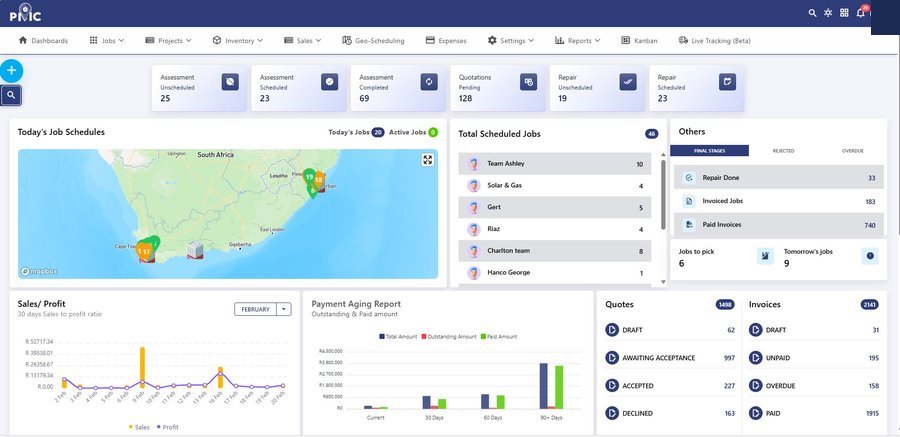
Before I talk about software, I want to describe the WhatsApp chaos phase, because every contractor who’s grown from solo to 3–5 teams knows exactly what I mean.
The typical morning at 3 teams looked like this: Six WhatsApp groups (one per team, one for “all crew”, one for emergencies, one for the Digicall coordinator, one for OUTsurance, one for the materials supplier). My phone had 340 unread messages by 8am. Half of them were questions I’d already answered in a different group. One was a technician asking for an address that was already in the job email I’d forwarded at 11pm the previous night.
Every morning started with me manually copying Digicall job details from the dispatch email into a WhatsApp message: job number, client name, address, phone number, job type, SLA deadline. For every job. At 5am. Then sending it to the right team WhatsApp group and hoping they’d seen it by 7am.
When I expanded to 3 teams, I was spending 45 minutes every morning on this admin before any actual work happened. By the time I had 5 teams, I had a part-time admin assistant whose entire job was managing the WhatsApp chaos. That’s when I knew something had to change.
2022: Growing to 3 Teams — The First Cracks
By 2022 I had 3 teams. The WhatsApp chaos was real. Three group chats, messages being missed, jobs getting assigned to the wrong team because someone didn’t see the update. My SLA compliance was dipping because I was manually tracking deadlines in a spreadsheet that didn’t alert me.
I was spending 45 minutes every morning on pure admin before any actual work happened. Something had to change.
Tried Tradify (2022)
Tradify solved the basic problems. Proper job cards, scheduling, invoicing, a real mobile app for the team. For a single-city operation with 3 teams, it worked well. Clean interface, reliable, polished after 11 years in the market. I was genuinely happy for about 8 months.
Then I decided to expand to Johannesburg. Everything changed.
2023: Expanding to Johannesburg — Everything Broke
Expanding to Johannesburg seemed straightforward in theory. I had strong insurance panel relationships, technical skills, and a proven operation model. What I didn’t have was software that could handle two separate operations running simultaneously.
Multi-Branch Chaos: The Problem Tradify Couldn’t Solve
With Tradify, everyone in the company sees everything. All jobs, all customers, all staff, regardless of which province they’re in. My Johannesburg manager was seeing Cape Town emergency jobs and panicking that he needed to respond. My Cape Town technicians were seeing Johannesburg inventory levels and ordering stock they thought was running out.
The breaking point came when my Johannesburg manager accidentally assigned a Durban emergency job to a Cape Town technician — he saw it pop up on his screen, assumed it was his to handle. The technician drove to the airport before I caught it. R2,400 in wasted fuel and a missed SLA deadline.
I couldn’t separate the financials either. I had no idea whether my Johannesburg operation was profitable independently, or whether it was being subsidised by Cape Town. I was flying blind on the most important business decision I’d made.
The real cost of no multi-branch management: R2,400 in wasted fuel on a single incident. Repeated weekly in smaller ways across both operations. Estimated monthly waste from miscommunication: R8,000–12,000.
Called Tradify Support (2023)
I called Tradify and asked about multi-branch management. The support person was helpful and honest: “Tradify is designed as a single-company system. For multi-location operations, you could create separate accounts.”
Separate accounts meant separate subscriptions, no consolidated reporting across provinces, and manual data syncing. Not a solution. Not even close.
Tried Jobber (3 Months, 2023)
Jobber is the North American equivalent of Tradify — polished, reliable, good for small to medium operations. I spent 3 months and R12,000 in subscription fees finding out it had exactly the same problem: single company structure, cloud-dependent (brutal during load shedding), no SA insurance workflows, no GPS enforcement.
Three months, zero progress on the core problem.
Researched ServiceTitan (2023)
ServiceTitan is the enterprise platform used by large US home services companies. It has multi-branch management, robust insurance workflow capabilities, GPS tracking. The price: R50,000+/month. For a 3-province SA contractor managing 8 teams at the time, completely unaffordable. I’d have needed R7M+ in annual revenue just to justify the software cost.
2024: The Decision to Build
By early 2024 I had spent R80,000 testing software that fundamentally didn’t work for my specific situation. The core problems remained unsolved:
- No affordable multi-branch management for SA contractors
- No GPS enforcement that actually blocked fraudulent clock-ins (not just tracked location after the fact)
- No software built around SA insurance panel workflows — Digicall parsing, SLA timers, DAS tracking
- No offline-first mobile app that actually worked through 6-hour load shedding blocks
I made the decision to build it. Not because I wanted to be a software founder — I wanted to run a contracting business. But the tool I needed simply didn’t exist at a price SA contractors could afford. If I was going to solve my own problem, I might as well solve it for every SA contractor in the same position.
Building PlanMyCrew (March–August 2024)
I worked with a development team and we built PlanMyCrew over 6 months. Every single feature in the product came from a real problem I had experienced:
- 40m GPS enforcement: Because I’d discovered R14,400 in annual fuel fraud that basic GPS tracking did nothing to prevent
- Multi-branch management: Because the Johannesburg expansion had nearly cost me both operations
- SLA countdown timers: Because I’d received a formal warning letter from OUTsurance for 87% SLA compliance
- Digicall email parsing: Because I was manually typing job numbers at 11pm every night for years
- Offline-first mobile app: Because Cape Town load shedding was making cloud-dependent apps useless for 6-hour windows
- Province-level P&L: Because I had no idea which province was actually profitable
2024: Adding Durban — Testing PMC at Scale
In mid-2024, while still building PMC, I opened a third province in KwaZulu-Natal. This was partly a business decision (strong insurance panel demand in Durban) and partly a stress test for PMC. If the software couldn’t handle 3 provinces simultaneously, I needed to know before I launched it to other contractors.
The multi-branch management worked exactly as designed. My Durban manager only saw Durban jobs. My Cape Town and Johannesburg teams had no visibility into KZN operations. I could see all three provinces simultaneously from a single consolidated dashboard. For the first time in two years, I felt in control of my business.
2025: Results Using PlanMyCrew
- R13.14M annual revenue (2025)
- 98.3% insurance panel SLA compliance (up from 87% on Tradify)
- R14,400/year fuel fraud eliminated using 40m GPS enforcement
- 3 provinces operating independently with clear P&L separation
- 487 jobs completed (2025)
- Zero SLA warning letters since switching to PMC
- Admin time: 45 minutes/day down to 8 minutes/day
The numbers are real. I use PlanMyCrew daily in my own contracting business. If it stopped working, my business would suffer first. That’s why I’m confident recommending it.
The R80,000 Education
People ask me what R80,000 in software testing actually looks like. Here’s the breakdown:
- Tradify (6 months): R3,200/month × 6 = R19,200 in subscription fees. Plus approximately R15,000 in staff time spent on training, data migration, and setup that ultimately had to be undone when we switched.
- Jobber (3 months): R4,000/month × 3 = R12,000. Plus R8,000 in setup and migration costs.
- ServiceTitan evaluation: No subscription cost (I stopped at the demo stage when I saw R50,000/month), but R4,000 in consultant time getting a proper demo and evaluation.
- Opportunity cost: The time I personally spent researching, testing, configuring, training my team, and then undoing everything when each platform failed — conservatively 200+ hours at my effective hourly rate = R20,000+.
- Total: R78,200 — rounded to R80K.
The money was painful. The time was worse. Six months of running operations on software that was fundamentally wrong for our situation. Every week I was working around limitations instead of working on the business.
What I Almost Did Instead
At the point where I made the decision to build PMC, I almost chose a different path: hire a dedicated operations manager whose entire job would be to manage the multi-province chaos manually.
The salary for that person would have been R35,000–45,000/month. That’s R420,000–540,000/year. The person would have had to manage the cross-province job assignment, the SLA tracking spreadsheet, the Digicall email inbox, the fuel fraud monitoring, and the province-level financial reconciliation. Manually. Every day.
And the moment they got sick, left, or made a mistake — the operation would be exposed. A system built around one person’s knowledge and attention is fundamentally fragile.
Building PMC cost approximately R320,000 in development costs over 6 months. Year 1 comparison: R320K build vs R480K salary. Year 2 onwards: R42K/year (PMC subscription for 10 users) vs R480K/year (salary + overhead). The build decision was overwhelmingly correct on pure financials, before even considering reliability and scalability.
The Durban Expansion Lesson
Adding KwaZulu-Natal in mid-2024 while simultaneously building PMC was either foolish or brave — I’m still not sure which. But it taught me something important about how multi-branch management actually works in practice vs in theory.
The theory: clear province separation, clean P&L, manager autonomy. The practice in those first 6 weeks (before PMC was fully operational): I was doing everything manually in a spreadsheet. Durban jobs in one tab, CT in another, JHB in a third. Constantly switching. Making mistakes. Once I accidentally paid a Durban technician from the CT payroll and didn’t notice for 3 weeks because the spreadsheet didn’t flag cross-province transactions.
When PMC came online for the Durban branch in August 2024, the province immediately ran itself. My Durban branch manager had his own login, his own dashboard, his own job queue. The first month after deployment I received exactly one phone call from Durban: a question about the customer notification settings. Every other operational decision happened independently, within the province, without me.
That’s what systems do. They make the business independent of the founder’s daily involvement.
2026: Making PMC Available to Other Contractors
After 18 months running my own business on PMC and proving the results, I made the decision to open it up. The problems I solved aren’t unique to me — every SA contractor expanding beyond one city faces the same multi-branch challenge, every SA field contractor faces the same SLA compliance pressure, every contractor managing multiple teams loses money to fuel fraud.
PMC is now available from R149/month with a 30-day free trial. See how it compares to ServCraft, Tradify and Eworks →
What I Learned Building PMC
Lesson 1: International Software Doesn’t Understand SA
Tradify was built for New Zealand contractors. Jobber for Canadian ones. Their developers have never dealt with a 6-hour load shedding block in the middle of a critical job, never worked on a Digicall panel, never lost R14,400 to fuel fraud because GPS tracking showed where the team went but couldn’t block them from clocking in from the wrong location. The features SA contractors need don’t exist in international software because the problems don’t exist in their markets.
Lesson 2: You Can’t Manage What You Can’t Measure
Before PMC I had no idea that my KwaZulu-Natal operation had a 32.8% profit margin while Gauteng was running at 26.2%. I was making strategic decisions about expansion, staffing, and pricing based on gut feel rather than data. The moment I had province-level P&L separation, I could make actual business decisions: find out why Gauteng margins were lower, fix it, and increase overall profitability.
Lesson 3: Systems Scale, People Don’t
The reason my business broke at 3 teams wasn’t team size — it was that I was the system. Every job assignment went through me because there was no automated workflow. Every SLA deadline was tracked by me because there were no automated timers. Every invoice was assembled by me because no system was doing it automatically. PMC automated the workflow so the business could scale without me being the bottleneck for every decision.
Lesson 4: Build for YOUR Problems, Not Imagined Problems
Every feature in PMC came from a real, painful, expensive problem I experienced. The 40m GPS came from losing R14,400 in one year. The SLA timers came from a warning letter from OUTsurance. The multi-branch came from the Johannesburg disaster. The offline mode came from Cape Town load shedding. The best software is built by people who live the problem daily — not by people who researched the market from a conference room.
Why I’m Sharing This Story
Because if you’re a SA contractor at 3–5 teams thinking about expanding, or already expanded and struggling with the same multi-province chaos I experienced, I want you to know there’s a solution built specifically for you.
I wasted R80,000 and two years finding out what didn’t work. You don’t have to.
Try PMC Free for 30 Days
No credit card required. If it doesn't work for your operation, it's free to leave. I built PMC because I needed it — if you're facing the same problems, it will work for you too.